The Wardrobe in My Head Looks Better Than the One in My Closet
How many times have you opened your closet today?
Once? Twice?
While writing this article, I opened mine at least twenty times. That doesn’t include digging through my dresser or the two fabric storage bins I keep under my bed.
Over the years, I have somehow built a sustainable time capsule in the form of clothing. I own a reliable pair of jeans, at least two white shirts, three black shirts on rotation, and enough neutral basics to survive any last-minute invitation. My wardrobe is practical, reliable, and safe. And that’s exactly the problem because the wardrobe in my head looks nothing like the one hanging in my closet.
The version in my head belongs to someone far more interesting. My fictional closet consists of statement coats, colors, and fashion risks. The clothes in my fictional closet scream that I have somewhere important to be, even if I am buying toothpaste. Instead, I’m standing in front of my actual closet, currently deciding between Black Shirt #1 and Black Shirt #3. Somewhere between childhood and adulthood, I traded personal style for practicality. And I don’t think I’m the only one.
In April 2025, fashion writer Annika Lautens published an article in Fashion Magazine exploring a surprisingly simple question: Why is everyone dressing the same? Fashion, she argues, is supposed to be about identity and community. It is one of the most visible ways we communicate who we are to the world. So what does it say about us when we all start looking alike? It’s one thing to match your best friend accidentally. It’s another thing when you walk into a room full of strangers and realize everyone somehow arrived wearing the same trench coat, sneakers, and neutral color palette despite never coordinating beforehand.
Lautens points to social media, trend cycles, and dupe culture as major contributors. Instead of developing personal style, many of us are chasing aesthetics. We are no longer asking ourselves, “Do I like this?” We are asking, “Will people recognize this?” One example that immediately came to mind was the Birkin bag.
Growing up, the Hermès Birkin existed almost as a myth. It represented a level of exclusivity that most people would never personally experience. It was the type of bag you saw in magazines and on celebrities, not while scrolling through your local Walmart website. Now, thanks to social media and dupe culture, everyone has some version of a Birkin.
To be clear, there is nothing inherently wrong with that. But it does reveal something interesting about the way we consume fashion today. Many people are no longer chasing what an item means to them personally. They are chasing what the item represents socially. And that difference matters.
Fashion is supposed to be an extension of who you are. It tells people something before you even open your mouth. Maybe you’re someone who dresses simply despite having a huge personality. Maybe you’re quiet and prefer your clothes to do the talking for you. Or maybe your style is playful, dramatic, nostalgic, or completely impractical.
Whatever the case, style is one of the few ways we can communicate individuality before speaking a single word, which is why I think so many people have become afraid of it.
While reading Lautens’ article, I found myself thinking about middle school. My particular obsession at the time was anime. If I wasn’t doodling characters in my notebooks, I was probably trying to dress like someone who had just stepped out of a Japanese fashion magazine. This was long before East Asian pop culture became mainstream in the United States. Long before K-pop became a global phenomenon and before every other person on social media seemed to own a lightstick.
As a result, I got made fun of—a lot. But looking back, I am strangely grateful for that phase. Not because every fashion decision I made was a good one. Trust me, some of them absolutely were atrocious. But younger me was not afraid of being perceived. She was willing to experiment with her clothes and be different at the risk of looking ridiculous.
And honestly, I think that is a quality we have lost over time. At some point, we stop asking ourselves what we genuinely like and start asking ourselves what will blend in. The fear of being perceived is a fascinating thing. We talk about it constantly online when it comes to posting photos, sharing opinions, or putting ourselves out there creatively. But I think it shows up in our closets, too.
The truth is that most people are not afraid of fashion. They are afraid of judgment. This is exactly what I was thinking about as I opened my closet for what felt like the twenty-first time. Instead of reaching for Black Shirt #1 or Black Shirt #3, I pulled out a purple-and-white checkered Hill House nap dress that had been sitting untouched in the back of my closet for months. I paired it with my white Converse heels and a JW Pei bag.
The dress is frilly, and the shoes are unconventional. Neither choice exactly blends into the sea of black-and-gray New York City uniforms. But you know what? I like it. And that is becoming increasingly important to me.
Social media can be a fantastic source of inspiration. I discover new brands, new silhouettes, and new ideas all the time because of it. But at a certain point, personal style requires making decisions for yourself. The outfit I chose that day made me feel stylish, confident, and like myself. I believe that is what personal style is supposed to do.
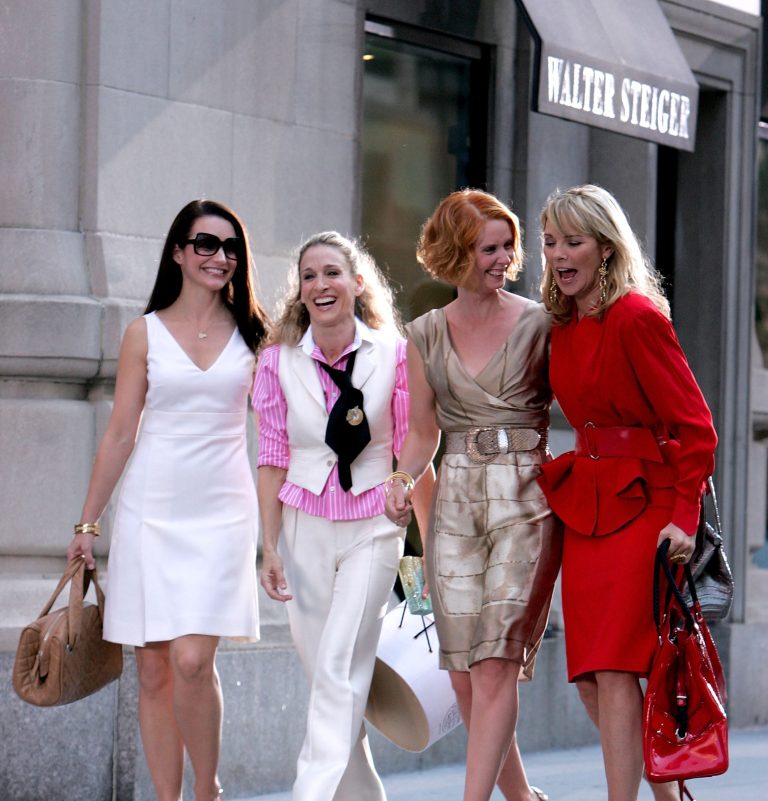
Not to help us fit in, but to help us recognize ourselves. Maybe the wardrobe in your head isn’t asking you to buy more clothes. Maybe it is asking you to be a little braver. When I think about the outfits I wish I wore, I rarely envy the clothes themselves. I envy the confidence of the women wearing them. I envy the way they gave themselves permission to be seen and different. To take up space and let themselves be known.
I believe personal style was never really about fashion. It was about self-expression and curiosity. Allowing yourself to become recognizable—not to other people, but to yourself.
And if all else fails, remember: even Sam, Alex, and Clover had a different outfit every episode.